The best agent might not win
How agents compete, learn, and adapt


TL;DR
We put eight models in 954 cage matches to test whether the best model always wins. Each model selected challenges designed to exploit its opponent’s weaknesses, scoring points only when it answered correctly and its opponent failed.
The results were surprising. DeepSeek V4.1 Flash won the heavyweight class despite not having the strongest answers. And GPT-6 Sol, the weakest model in that class by answer performance, won 17 of 20 matches against the strongest when both had access to scouting reports.
We analyzed the models’ decisions and identified five strategies. The most effective was to repeat a previous win against the same opponent. Models initially struggled to identify their opponents’ weaknesses, but improved as they accumulated evidence. Giving them a scouting report doubled the advantage they gained from their selections.
The takeaway: An agent’s ability to make strategic decisions can matter as much as its ability to complete the underlying task. Benchmarks measure what a model can do. They don’t necessarily measure how effectively it competes against another agent.
Introduction
Most model benchmarks measure how well a model answers questions or completes tasks. But as agents increasingly interact with other agents, success may depend on more than their individual capabilities.
Consider a buyer’s agent negotiating with a seller’s agent, or a red-team agent testing another agent’s defenses. In both cases, understanding the other agent’s strengths and weaknesses can affect the outcome.
We wanted to understand how models make decisions in these competitive environments, and whether stronger performance on standalone tasks translates into winning against another model.
So we built a game where eight models competed in 954 cage matches, selecting challenges to gain an advantage over their opponents. We analyzed the strategies they developed, how those strategies changed as they learned about their opponents, and whether access to past performance data affected the results.
We found that the models with the strongest answers didn’t always win. In closely matched competitions, identifying and exploiting an opponent’s weaknesses could overcome an advantage in task performance.
How we ran the cage matches
We designed a card game where eight models competed against one another by choosing challenges from a shared deck.
The deck contained 562 challenges across 17 categories, including logic puzzles, mathematics, coding, and tool use. Each model answered every challenge before the matches began. During the matches, models selected which challenges would count toward their scores rather than solving new problems.
Each match consisted of 30 rounds:
- Draw six cards. Each card represented a challenge from a different category. Models could see the category and type of challenge, but not the question itself.
- Choose a card. Both models independently selected one of the six challenges.
- Score the round. A model earned a point when it had answered a selected challenge correctly and its opponent had answered incorrectly. If both models were correct or both were incorrect, neither earned points.
- Reveal the results. Both models saw how they and their opponent had performed on all six challenges, including those neither selected.
Each model could also designate five of its selections per match as triple cards, worth three points instead of one.
We gave the models the rules, but no advice on how to win. Each model also had to explain its selection in two to four sentences, allowing us to analyze the strategies it reported using.
Dividing the models into weight classes
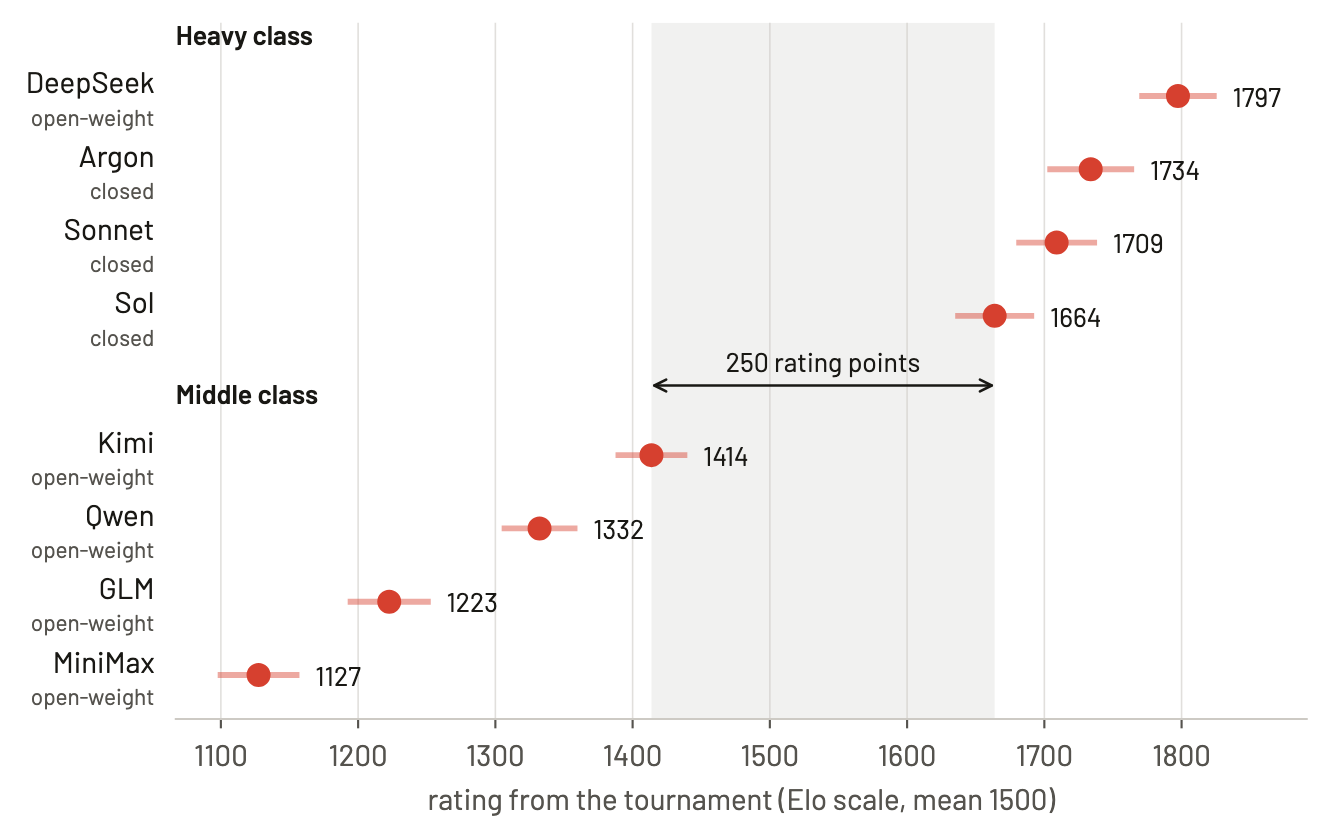
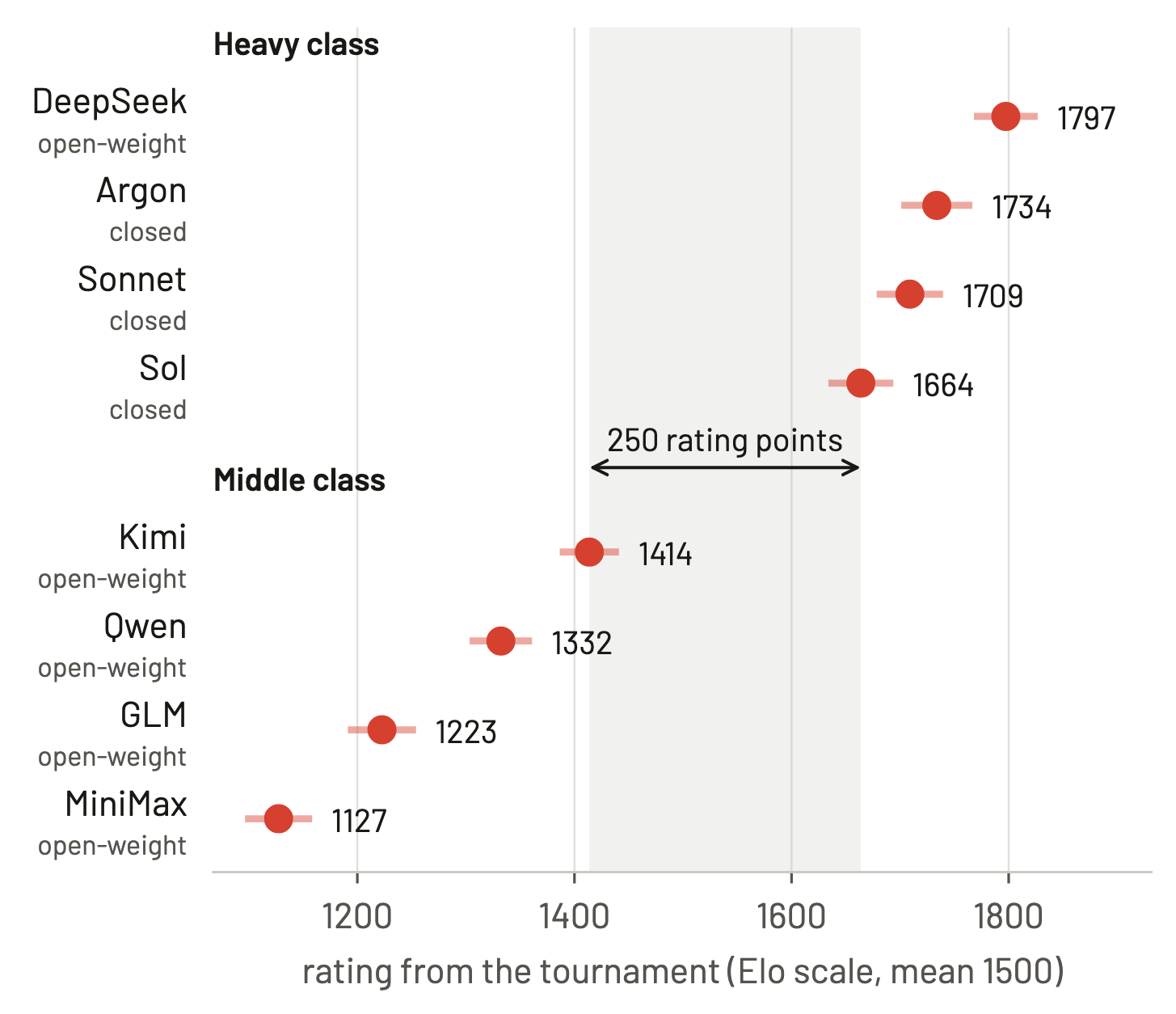
We began with a tournament in which every pair of models played 12 matches. The results revealed two distinct groups of four models, separated by approximately 250 Elo rating points.
Models in the stronger group won about nine out of ten matches against models in the weaker group. To make the competition more balanced, we divided them into two weight classes: heavyweight and middleweight.
Within each class, every model played 60 matches: 20 against each of the other three models.
Finding 1: The best answers don’t guarantee a win
DeepSeek V4.1 Flash won the heavyweight class, beating three closed models: Gemini 4 Argon, Claude Sonnet 5.5, and GPT-6 Sol.
It won 39 of its 60 matches and finished first again in an additional series of 42 matches.
But DeepSeek didn’t have the strongest expected answer performance.
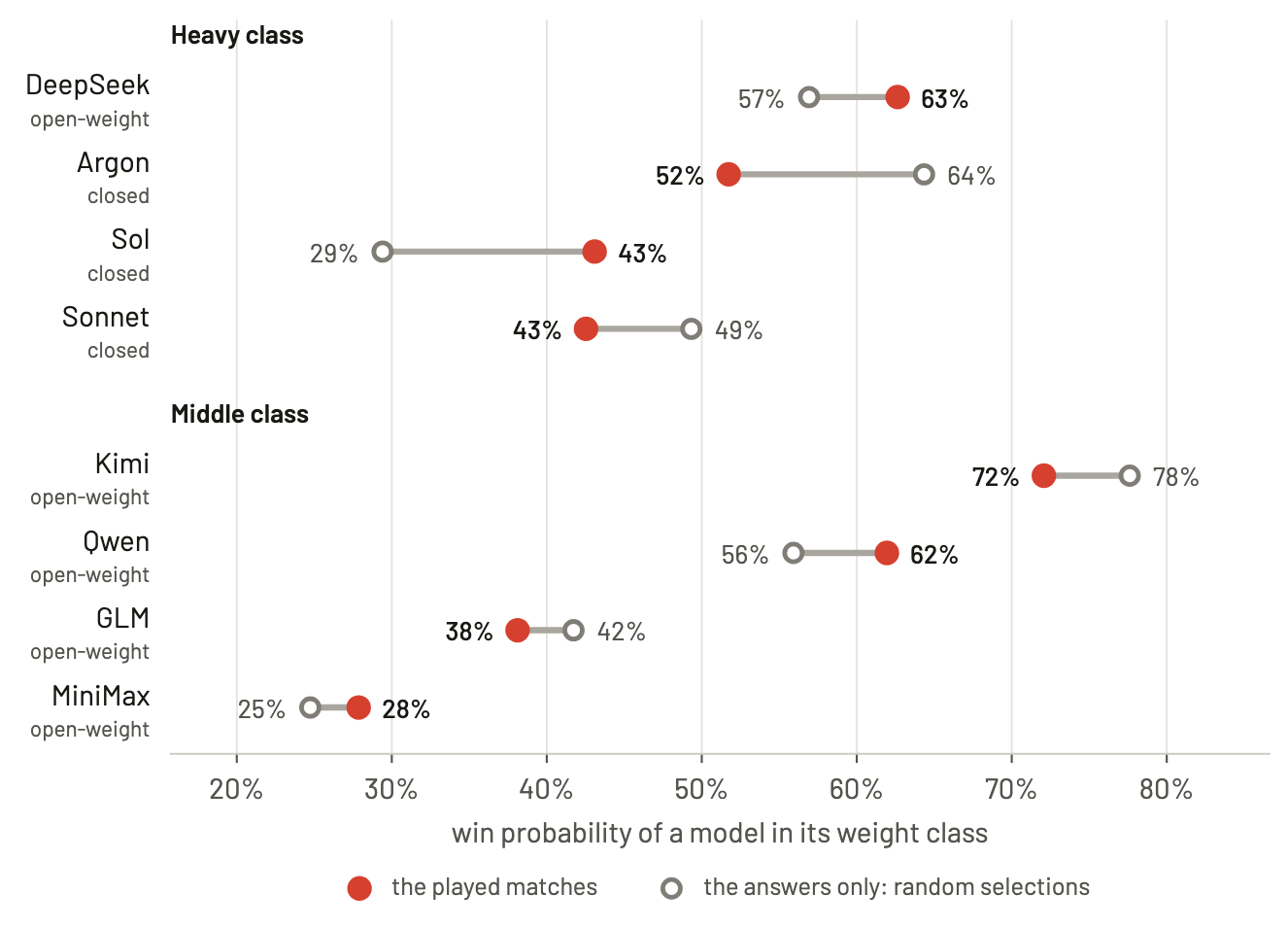
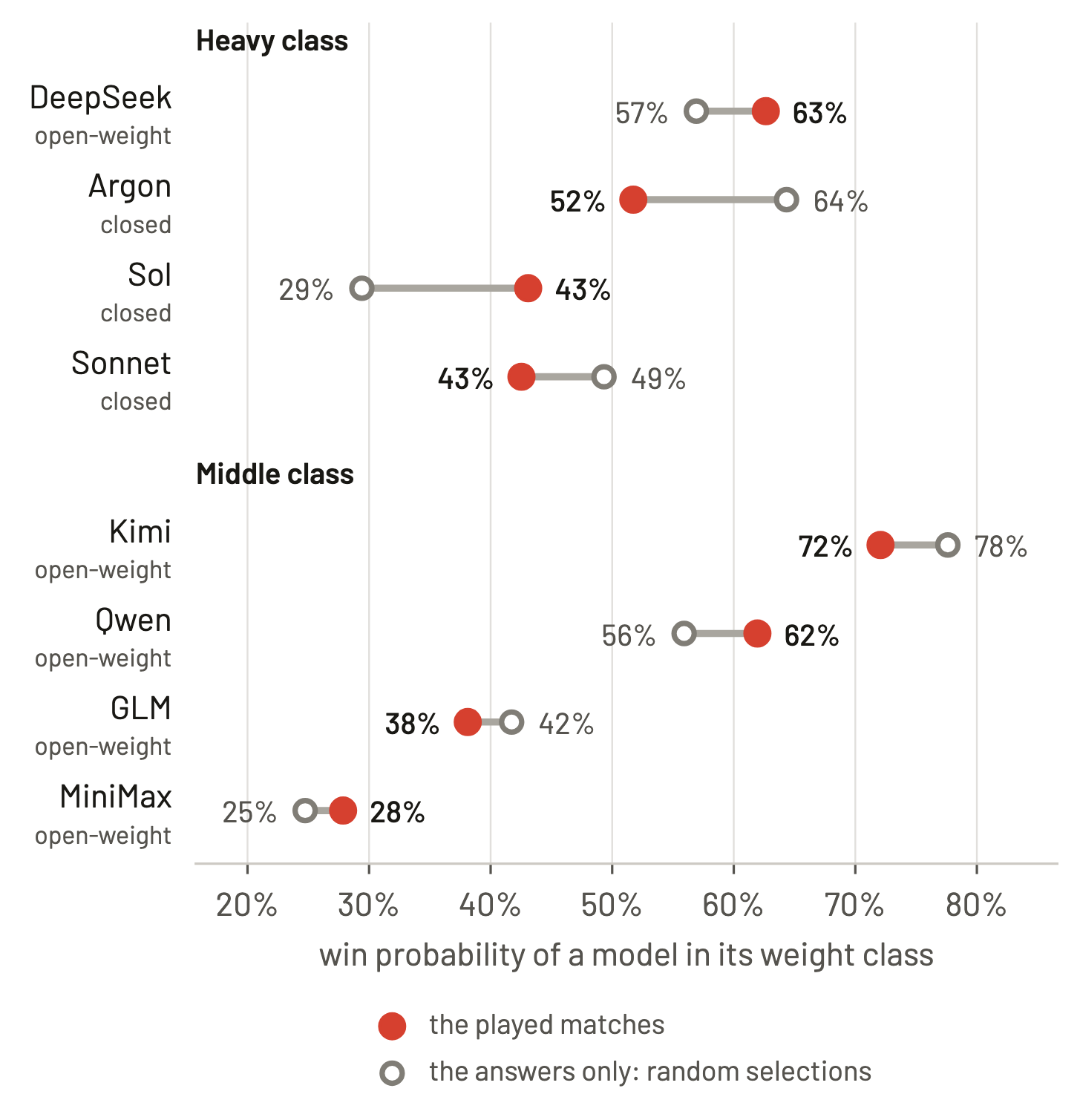
To separate task performance from strategic decision-making, we calculated how often each model would win if both opponents selected challenges at random. This gave us a baseline based on their answers alone, without any advantage from choosing particular challenges.
By that measure, Gemini 4 Argon was the strongest heavyweight model, with a 64% expected win rate. DeepSeek came second at 57%.
Yet in the actual matches, Gemini won only half its games, while DeepSeek won 39 out of 60.
The difference was especially pronounced among closely matched models.
When models from different weight classes competed, the model with better answers won 91% of the time. But within the heavyweight class, that figure fell to just 61%.
GPT-6 Sol provides another example. It had the weakest answers of the heavyweight models, with an expected win probability of just 29% under random selection. Yet its strategic selections improved that probability to 43%, bringing it close to Gemini’s performance.
The middleweight class was different. Kimi K3.1 Pro, which had the strongest answers, also won the most matches. All four middleweight models finished in the same order as their underlying answer performance.
When differences in task capability were large, the stronger model usually won. But when capabilities were closer, the models’ decisions about which challenges to select could change the outcome.
We next looked at what those decisions had in common.
Finding 2: Models developed five strategies. One dominated.
We gave the models no advice on how to win. But across thousands of decisions, patterns emerged in how they explained their choices.
We analyzed their stated reasons and identified five strategies:
| Strategy | What it is about | What the model does | In the words of a model | Share of the decisions |
|---|---|---|---|---|
| Repeat the win | Who solves the card | The model was correct in this family of cards before, and its opponent was not. | "On both previous 64-step state-tracking cards, I was correct and my opponent was wrong." (GPT-6 Sol) | 59% |
| Play my strength | Who solves the card | The model expects a correct answer from itself. It does not compare with its opponent. | "AIME problems have been reliable for me, though the opponent solves them too." (Claude Sonnet 5.5) | 16% |
| Guess a difference | Who solves the card | The model has no such result. It guesses which card gives different results for the 2 models. | "I choose the hard Code problem because I believe my coding ability gives me a comparative advantage over the opponent." (DeepSeek V4.1 Flash) | 12% |
| Play the score | The score of the match | The model is ahead and selects a safe card, or it is behind and takes a risk. | "I lead 8-2, so I want low variance." (Claude Sonnet 5.5) | 8% |
| Attack a weak point | Who solves the card | The model expects that its opponent fails, from the record or the name of its opponent only. | "My opponent is a Flash-tier model, which may struggle more with hard, graduate-level calculation questions in Chemistry." (Gemini 4 Argon, about DeepSeek V4.1 Flash) | 5% |
Table 1. The 5 strategies that the models invented. Each quote is a part of a stated reason from a match of the tournament. The share is for the decisions of the weight-class matches.
One strategy dominated: Repeat the win.
We measured each strategy’s effectiveness by comparing the points earned from its selections with the expected points from selecting a card at random. Repeat the win accounted for 96% of the points models gained above random selection.
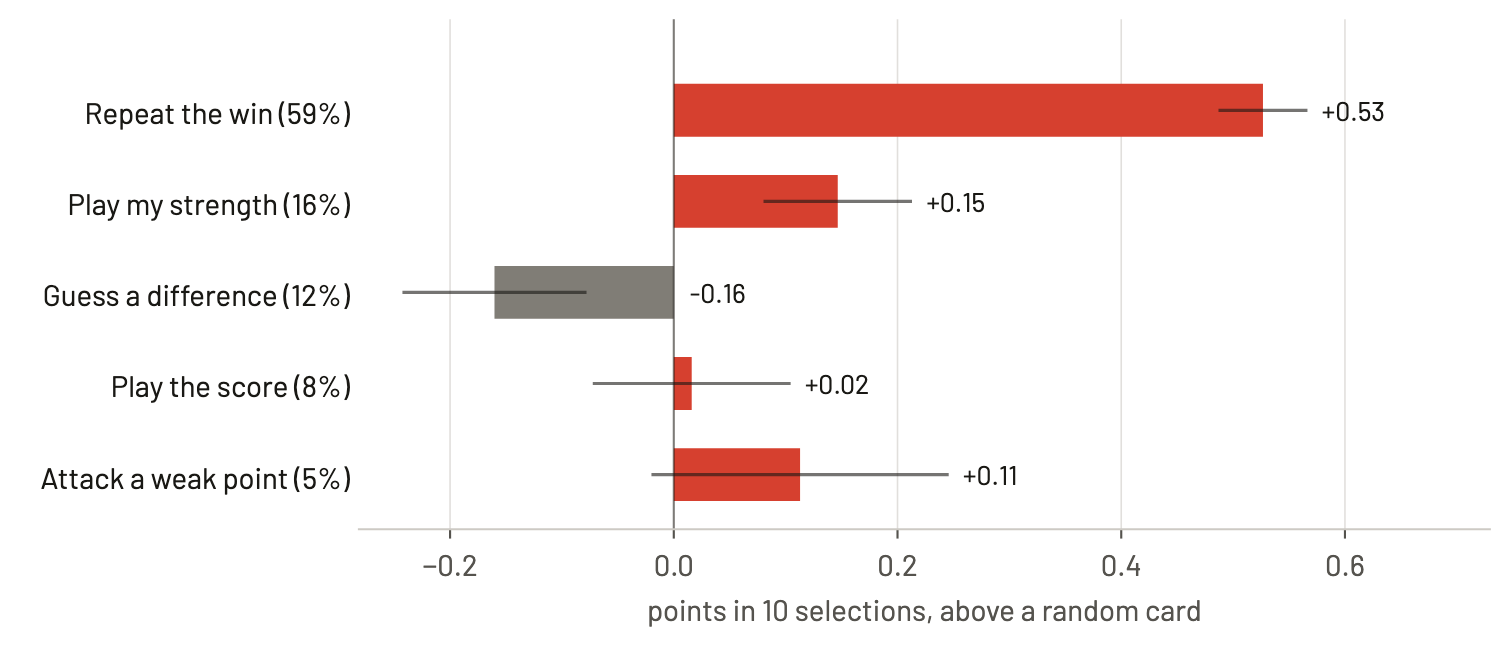
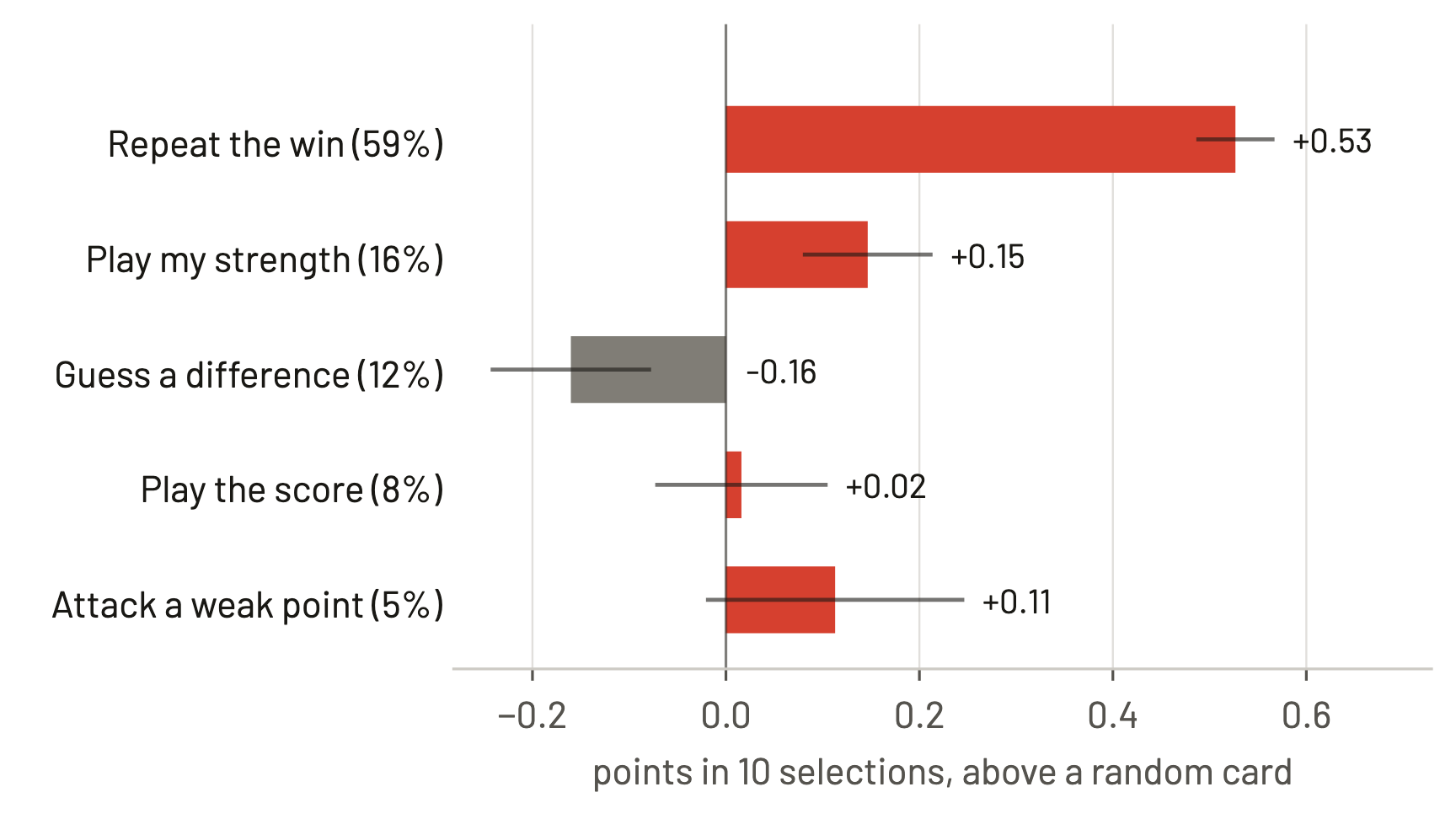
The strategy worked because models earned points only when they answered correctly and their opponent failed. Choosing an easy challenge wasn’t enough if the opponent could solve it too.
By selecting challenges similar to ones they’d previously won, models could identify where they had an advantage. And because no challenge appeared twice, they had to apply that knowledge to new problems.
Other strategies were far less effective. Models that played to their own strengths often selected challenges their opponents could also solve. Others made assumptions based on an opponent’s reputation. Gemini 4 Argon, for example, chose a difficult chemistry challenge because it expected a “Flash-tier model” to struggle. Its opponent, DeepSeek V4.1 Flash, answered correctly.
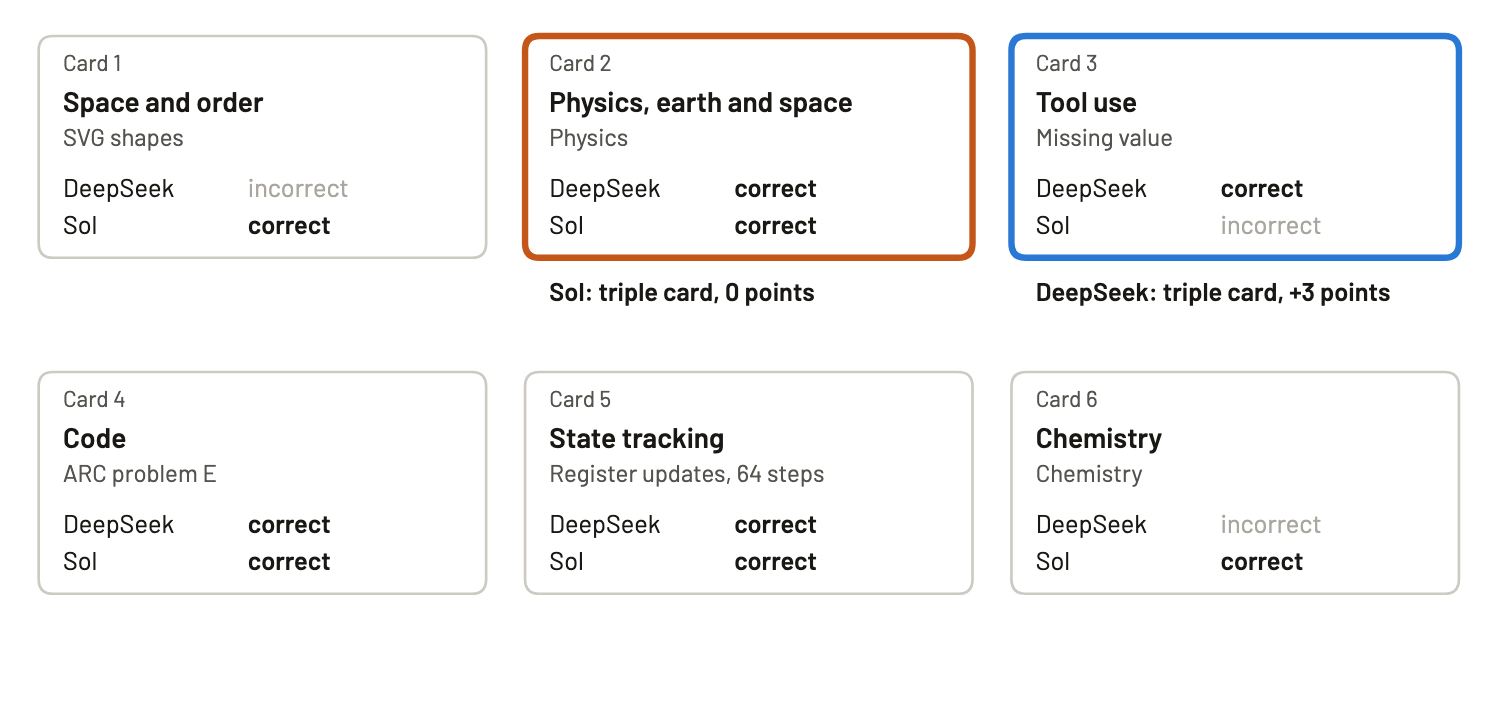
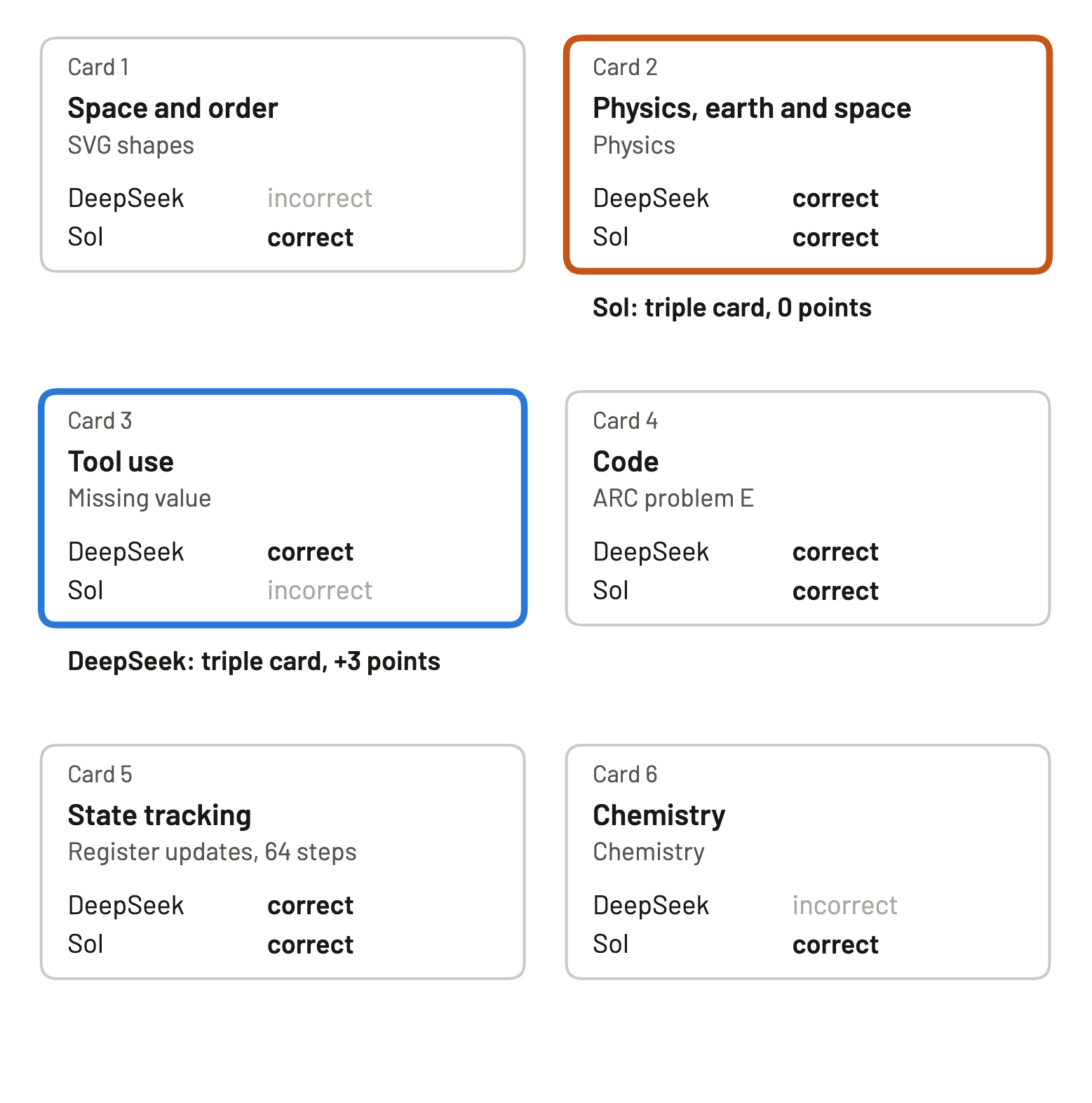
DeepSeek demonstrated the more successful approach in a match against GPT-6 Sol. After winning a tool-use challenge in round one, it selected two more challenges from the same family and assigned both triple-card bonuses. It won both, earning six points and ultimately winning the match.
As DeepSeek explained:
In round 1, I answered Tool use correctly while my opponent was wrong, giving me a clear edge in this family.
The most effective strategy relied on demonstrated differences in performance, not assumptions about what either model should be good at.
Finding 3: Knowing an opponent changes the game
In the first matches, models knew only their opponent’s name. They had to discover its strengths and weaknesses as the game progressed.
During the first five rounds, models selected challenges no better than random. Their decisions improved as they observed more results, with the advantage from their selections increasing until approximately round 20.
We wanted to see whether giving models information about their opponents upfront would change the outcome.
So we introduced scouting reports: records of how both models had performed on previous challenges. The reports contained no summaries or strategic advice, and excluded challenges from the upcoming match.
The effect was immediate. All eight models made better selections with scouting reports. Their advantage over random selection doubled, from 0.32 to 0.64 points per ten selections. With these records, models made effective decisions from the first round rather than spending most of the match learning about their opponents.
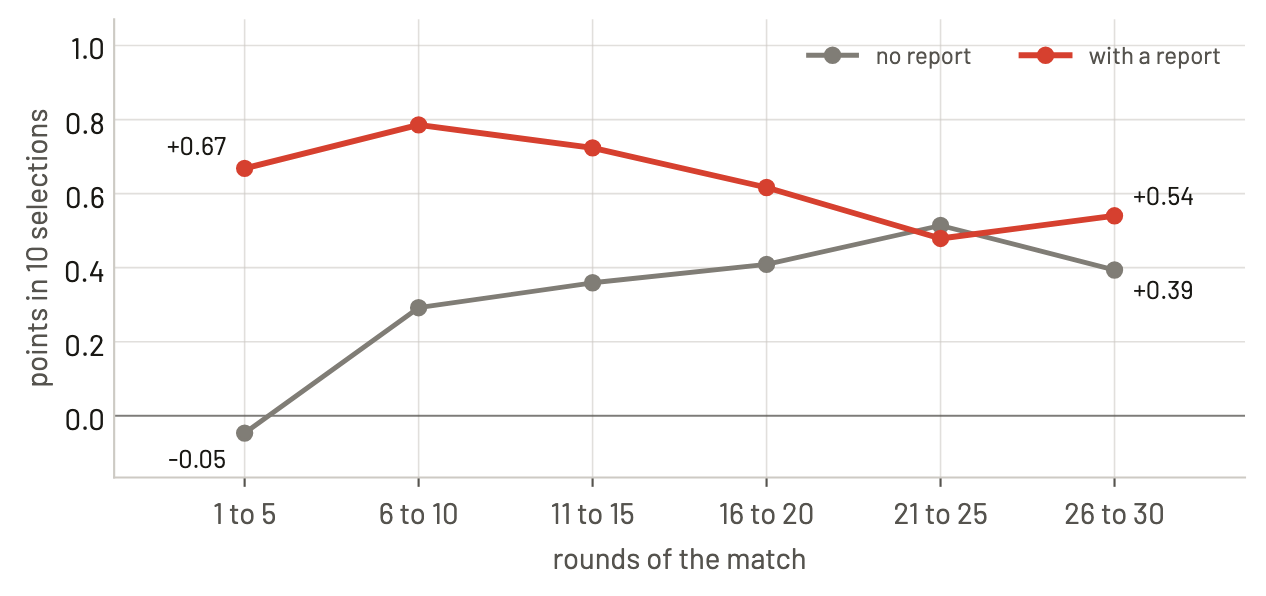
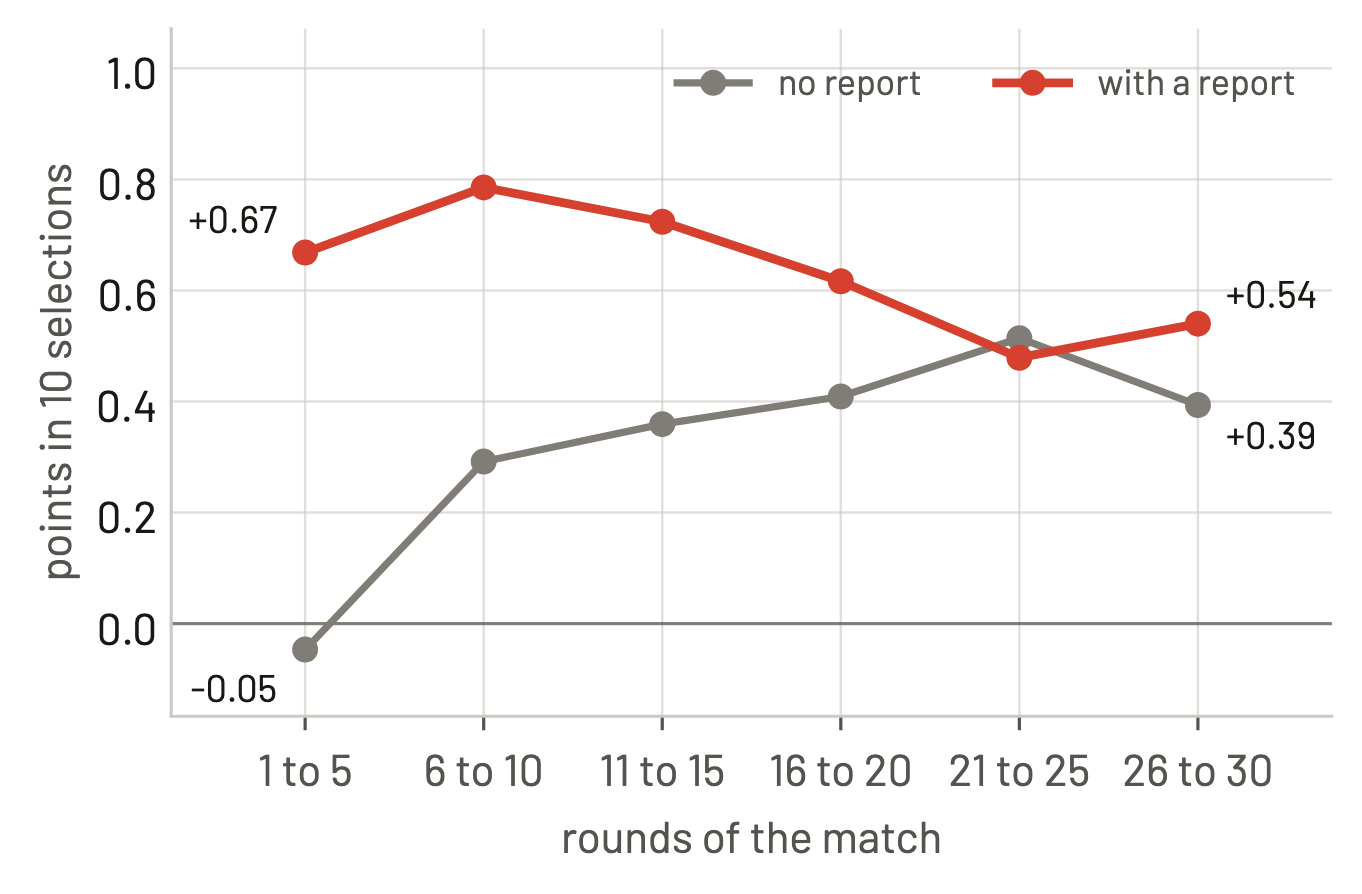
When only one model had a scouting report, its estimated win probability rose from 50% to 66%.
The weakest heavyweight model beat the strongest 17 times out of 20
Gemini 4 Argon had the strongest expected answer performance in the heavyweight class, while GPT-6 Sol had the weakest. Yet when both models had scouting reports, Sol won 17 of their 20 matches, compared with 12 without them.
Sol identified a weakness in Gemini’s performance on state-tracking challenges. Sol had 96% accuracy on these challenges, compared with Gemini’s 52%.
With scouting reports, Sol allocated 79 of its 100 triple-card selections across their matches to state tracking, up from 50 without them.
As Sol explained in one match:
On prior 64-step state-tracking challenges, I was consistently correct while my opponent was often wrong.
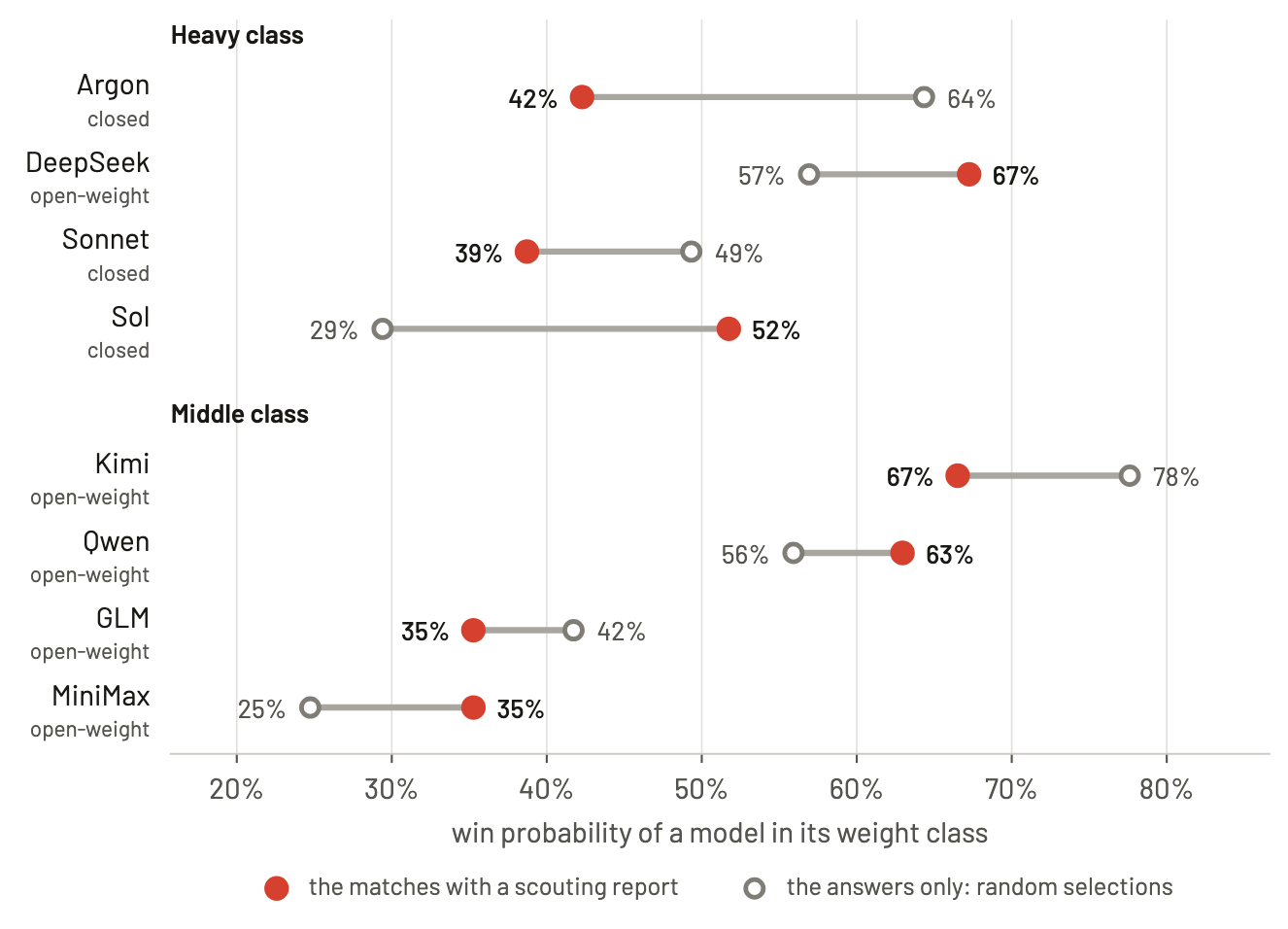
Across the heavyweight class, the model with better answers won just 51% of matches when both competitors had scouting reports, compared with 61% without them.
The additional information didn’t make models better at answering questions. It helped them identify which questions gave them the greatest advantage.
What this means for multi-agent systems
As agents increasingly interact with other agents, standalone benchmarks may not tell the whole story. Our findings suggest three implications for engineers:
- Test agents against their opponents. Standalone task performance doesn’t necessarily predict how an agent will perform against another agent.
- Give agents access to past results. Even simple records of previous interactions can help agents identify and exploit an opponent’s weaknesses.
- Examine how agents make decisions. Understanding the strategies behind their choices can reveal weaknesses that task-success metrics miss.
The strongest model doesn’t always win. How effectively an agent learns and adapts to its opponent can change the outcome.
Appendices
Appendix A: The deck, the game and the tests
The deck has 562 challenges from 7 sources. Before the matches, each model answered each challenge 3 times or more, with 1 exception, and we saved the answers. In a match, no model answers a challenge: the game draws 1 saved answer of each model for each card. So a model that selects a card predicts that its own answer is correct and that the answer of its opponent is not. For a win probability, we kept the selected cards of a match, and we drew the saved answers again 800 times or more. The gain of a selection is the expected points of its card minus the mean of the 6 cards of the round, for 10 selections.
| Source | Families of the cards | How we selected the challenges | In the pool | In the deck |
|---|---|---|---|---|
| SuperGPQA: graduate questions in science, technology, medicine and the humanities | 7 families: Chemistry, Electrical and computing, Humanities and social science, Mathematics, Mechanical and process engineering, Medicine and biology, Physics, earth and space | A sample with a fixed seed from the questions with the labels hard and middle | 350 | 216 |
| BIG-Bench Extra Hard: tasks of logic, language and everyday knowledge | 5 families: Counting and arithmetic, Everyday knowledge, Language and humor, Logic puzzles, Space and order | A sample with a fixed seed, from 22 of its 23 tasks | 148 | 123 |
| AIME 2025 and 2026, from MathArena: competition mathematics | Competition mathematics | All 30 problems of each year | 60 | 52 |
| Probability puzzles with urns, from our generator | Probability puzzles | 30 new puzzles at each of 2 levels | 60 | 51 |
| State tracking, from our generator | State tracking | 30 new puzzles with 32 update steps, and 30 with 64 | 60 | 47 |
| LiveCodeBench: a program that must pass hidden tests | Code | 24 tasks with the label medium and 24 with the label hard, selected with a fixed seed | 48 | 33 |
| BFCL, the Berkeley Function-Calling Leaderboard: tasks with tools in more than 1 turn | Tool use | 48 tasks, selected with a fixed seed: 12 for each of 4 forms of the task | 48 | 40 |
| Total | 17 families | 774 | 562 |
The 7 sources of the challenges: 5 public benchmarks and 2 generators of our own. The pool has 774 challenges, and the deck has 562 of them. Each challenge outside the deck has the same result for all saved answers of the 8 models, so it cannot give a point. In the deck, 517 challenges can give a point, and 45 cannot. The exception in the text: GLM-5.3 Flash has 2 saved answers for 1 challenge.
| Matches or test | Number | Design | Result |
|---|---|---|---|
| The tournament: each pair of the 8 models | 336 | 12 matches for each pair | The ratings show 2 groups, 250 rating points apart |
| The final series of the heavy class | 42 | 7 more matches for each pair | DeepSeek V4.1 Flash was first, with 13 wins in 21 matches |
| Weight classes, no report | 240 | 20 matches for each pair of a class: 144 matches of the tournament and 96 new matches | The stronger model won 65% of the matches |
| Weight classes, with a scouting report | 240 | The same matches a second time, with the same cards and the same saved answers | The gain went from 0.32 to 0.64 points in 10 selections, and 96% of the stated reasons compared the records of the 2 models |
| A report for only 1 model | 96 | The opponent of the model has no report | The model with the report won 58 matches. Its win probability was 66%, against 50% for the same cards with no report |
| An instruction to select by 1 of 3 rules | 144 | In each reply, a model gives 2 estimates for each card: the probability of a correct answer for itself and for its opponent. The prompt tells the 2 models to select by 1 of 3 rules: the highest estimate for their own answer, the lowest estimate for their opponent, or the largest difference. 48 matches for each rule, with a report | Applied to all these estimates, the rule of the own answer won 0.28 points in 10 selections, the rule of the opponent won 0.34, and the rule of the difference won 0.71. No instruction increased the gain of the models |
| An opponent that selects at random | 192 | A model against an opponent of its class, with no report and with a report | The play added 10 and 17 percentage points of win probability |
| A copy that selects at random | 48 | The control: a model against its copy | The win probability was 50% |
| Hidden results | 396 | A model plays the same 132 matches 3 times against an opponent that selects at random: with no results, with its own results, and with the results of the 2 models | Its own results added 0.12 points to its gain, and the results of its opponent added 0.30 points more |
| Estimates with no match | 960 calls | In each call, a model estimates the results of 6 challenges, for itself and for the 3 other models of its class, with a report or with no report | With no report, no model predicted where its opponent fails: each correlation of its estimates with the truth was between −0.08 and +0.07 |
The matches and the tests of the post. We count 954 matches between 2 models that play: rows 1 to 6, where the 144 tournament matches of row 3 are also in row 1.
Appendix B: The models and the weight classes
The ratings of the tournament and the accuracy on the deck give the same 2 classes. The 2 classes are 250 rating points apart, and 2 neighbors in a class are 109 rating points apart at most. A model of the heavy class won 175 of the 192 tournament matches between the 2 classes. In a class, each pair of models has 20 matches: its 12 matches of the tournament and 8 new matches. DeepSeek V4.1 Flash has the highest accuracy on the deck, but a match draws from each of the 17 families about equally. The mean accuracy of the 17 families is 80.3% for Gemini 4 Argon and 79.4% for DeepSeek V4.1 Flash.
| Class | Model | Type | Accuracy on the deck | Accuracy on state tracking | Rating in the tournament (error) |
|---|---|---|---|---|---|
| Heavy | DeepSeek V4.1 Flash | open-weight | 80.5% | 98% | 1797 (26) |
| Heavy | Gemini 4 Argon | closed | 79.4% | 52% | 1734 (30) |
| Heavy | Claude Sonnet 5.5 | closed | 80.0% | 100% | 1709 (27) |
| Heavy | GPT-6 Sol | closed | 76.9% | 96% | 1664 (27) |
| Middle | Kimi K3.1 Pro | open-weight | 72.1% | 97% | 1414 (24) |
| Middle | Qwen3.8-27B | open-weight | 69.2% | 100% | 1332 (25) |
| Middle | GLM-5.3 Flash | open-weight | 66.8% | 93% | 1223 (28) |
| Middle | MiniMax M3.1 Flash | open-weight | 64.2% | 96% | 1127 (28) |
The 8 models. The rating is a Bradley-Terry fit of the win probabilities of the tournament, on the Elo scale with a mean of 1500. State tracking is the family of the story of Finding 3. In its 20 matches against Gemini 4 Argon, GPT-6 Sol put 50 of its 100 triple cards on this family with no report, and 79 with the report.
| Model | Answers only | Win probability, no report | Wins and losses, no report | Win probability, with a report | Wins and losses, with a report | Gain, no report | Gain, with a report |
|---|---|---|---|---|---|---|---|
| DeepSeek V4.1 Flash | 57% | 63% | 39–21 | 67% | 41–19 | +0.44 | +0.68 |
| Gemini 4 Argon | 64% | 52% | 30–30 | 42% | 23–37 | +0.44 | +0.70 |
| GPT-6 Sol | 29% | 43% | 26–34 | 52% | 37–23 | +0.52 | +0.87 |
| Claude Sonnet 5.5 | 49% | 43% | 25–35 | 39% | 19–41 | +0.18 | +0.42 |
| Kimi K3.1 Pro | 78% | 72% | 41–19 | 67% | 40–20 | +0.25 | +0.41 |
| Qwen3.8-27B | 56% | 62% | 38–22 | 63% | 34–26 | +0.36 | +0.74 |
| GLM-5.3 Flash | 42% | 38% | 24–36 | 35% | 28–32 | +0.15 | +0.43 |
| MiniMax M3.1 Flash | 25% | 28% | 17–43 | 35% | 18–42 | +0.24 | +0.84 |
The fights in a weight class: each model has 60 matches with no report and 60 matches with a scouting report. A limit: a weight class has only 4 models. "Answers only" is the win probability of a model if the 2 models select at random. A win probability comes from new draws of the saved answers, so it can be different from the share of matches that a model won. The gain is in points for 10 selections, above a random card.
| Type of match | Matches of each kind | Lead from the answers, in points | Points from the selections of 1 model, no report | Selections of the stronger model, with a report | Selections of the weaker model, with a report | The stronger model won, no report | The stronger model won, with a report |
|---|---|---|---|---|---|---|---|
| Heavy class | 120 | 1.7 | 1.2 | 1.6 | 2.4 | 61% | 51% |
| Middle class | 120 | 3.0 | 0.7 | 1.5 | 2.1 | 69% | 68% |
| The 2 weight classes | 240 | 2.4 | 1.0 | 1.6 | 2.2 | 65% | 60% |
| Between the 2 classes, in the tournament | 192 | 6.5 | 1.5 | – | – | 91% | – |
Capability and play in each type of match. The lead from the answers is the expected lead of the stronger model at the end of a match. For this lead, the 2 models select their cards at random. The points from the selections are the expected points that the selections of 1 model add to its own lead, above random selections. The stronger model of a match has the better answers on the cards of that match.
Appendix C: The prompt and the scouting report
Each round is 1 call with 2 texts: the system prompt, and a round prompt with the past results and the 6 new cards. We did not mislead the models: each sentence of the 2 texts is true. The first text below is the system prompt of the match of Figure 1, for DeepSeek V4.1 Flash. With a scouting report, the system prompt also has 1 more rule and a list of results. The second text is this rule and the first 5 of the 322 lines of a report of GPT-6 Sol against Gemini 4 Argon. A line gives the family and the type of a challenge and the 2 results, with no question and no answer.
| Level of the record in a stated reason | Reasons | Share | Gain (error) |
|---|---|---|---|
| The exact type of the card | 2,596 | 72% | +0.68 (0.07) |
| The family of the card | 974 | 27% | +0.36 (0.10) |
| No record | 30 | 1% | +0.06 (0.32) |
The level of the record that a stated reason uses, for 3,600 stated reasons of the matches with a scouting report. A reason about the exact type of a card won more than a reason about its family. The gain is in points for 10 selections, above a random card. A limit: the report is the record of the same 2 models on the same deck, and a record from a different source can be worth less.
Appendix D: The 5 strategies in numbers
The judge model, GPT-6.1 Sol, gave each stated reason 1 main pattern from a codebook of 15 patterns. A strategy is a group of main patterns, so each decision is in 1 strategy. No person checked the labels: a second judge model labeled 219 decisions, and the 2 judges gave the same strategy for 89.5% of them. For the effect on the win probability, we replaced the cards of 1 strategy with random cards of the same rounds. In a weight class, the gain of "Repeat the win" is not larger than between the 2 classes, but its effect is larger. The gain of a strategy is a difference between decisions, and it is not a proved cause.
| Strategy | Main patterns of the codebook | Decisions | Share | Gain (error) | Gain against the other decisions of the same model (error) | Cards won, cards lost, and cards where the 2 models were correct | Effect on the win probability (error) |
|---|---|---|---|---|---|---|---|
| Repeat the win | Repeat the win | 8,520 | 59% | +0.53 (0.04) | +0.56 (0.11) | 17%, 11%, 56% | +9.0 (0.9) |
| Play my strength | Play my strength, Stay away from my weak point | 2,255 | 16% | +0.15 (0.06) | −0.27 (0.12) | 10%, 10%, 70% | +0.6 (0.3) |
| Guess a difference | Look for a difference, Try a new family | 1,683 | 12% | −0.16 (0.08) | −0.70 (0.23) | 11%, 13%, 62% | −0.3 (0.3) |
| Play the score | Protect the lead, Take a risk when behind | 1,226 | 8% | +0.02 (0.09) | −0.37 (0.09) | 8%, 9%, 72% | +0.3 (0.2) |
| Attack a weak point | Attack a weak point, Use the name of the opponent | 686 | 5% | +0.11 (0.13) | −0.12 (0.14) | 13%, 15%, 53% | +0.0 (0.2) |
| Other | Guess the card of the opponent, Count the evidence, Calculate the value, Plan the family limit, Use the table, A copy has no weak point | 92 | 1% | +0.28 (0.32) | −0.40 (0.34) | 11%, 12%, 71% | +0.1 (0.1) |
The 14,462 decisions of the 240 weight-class matches. The gain is in points for 10 selections, above a random card. The effect is in percentage points.
| Type of match | Lead from the answers, in points | Share of "Repeat the win" | Its gain (error) | Its effect on the win probability (error) | Effect of all cards of a model |
|---|---|---|---|---|---|
| Weight classes | 2.4 | 59% | +0.53 (0.04) | +9.0 (0.9) | +9.2 |
| Heavy class | 1.7 | 52% | +0.71 (0.05) | +13.5 (1.4) | +13.9 |
| Middle class | 3.0 | 65% | +0.38 (0.05) | +4.6 (1.0) | +4.5 |
| Between the 2 classes, in the tournament | 6.5 | 55% | +0.78 (0.04) | +5.4 (0.7) | +5.9 |
| All pairs of the tournament | 4.7 | 57% | +0.66 (0.03) | +6.3 (0.6) | +7.0 |
"Repeat the win" in each type of match. The lead from the answers is the lead of the stronger model with random selections: a small lead is a level fight. The 2 effects are in percentage points of win probability.
| Evidence in the stated reason | Decisions | Share | Gain (error) |
|---|---|---|---|
| 2 past results of the match or more | 8,494 | 59% | +0.47 (0.04) |
| 1 past result of the match | 3,545 | 25% | +0.29 (0.06) |
| A belief about the task or about models, and no result | 2,093 | 14% | −0.19 (0.07) |
| The name, the maker or the type of the opponent | 121 | 1% | +0.00 (0.31) |
The evidence that a stated reason gives, for all strategies. The table leaves out 209 decisions (1%) with other evidence or with none. In round 1, a match has no results: 59% of the decisions were "Play my strength", and the gain was −0.28 points in 10 selections.
| Model | Class | Repeat the win | Play my strength | Guess a difference | Play the score | Attack a weak point | Effect of all its cards |
|---|---|---|---|---|---|---|---|
| Kimi K3.1 Pro | Middle | 76% | 4% | 15% | 2% | 2% | +4 |
| Gemini 4 Argon | Heavy | 74% | 7% | 8% | 4% | 6% | +14 |
| GLM-5.3 Flash | Middle | 68% | 11% | 6% | 6% | 8% | +3 |
| MiniMax M3.1 Flash | Middle | 66% | 12% | 9% | 1% | 11% | +2 |
| DeepSeek V4.1 Flash | Heavy | 58% | 15% | 4% | 16% | 6% | +15 |
| GPT-6 Sol | Heavy | 55% | 8% | 29% | 7% | 0% | +20 |
| Qwen3.8-27B | Middle | 51% | 33% | 1% | 11% | 2% | +9 |
| Claude Sonnet 5.5 | Heavy | 22% | 34% | 20% | 20% | 2% | +6 |
The share of each strategy in the decisions of a model in the weight-class matches. The effect is for all cards of a model, in percentage points of win probability. GPT-6 Sol has the weakest answers of the heavy class, and the highest gain and the largest effect of the 8 models.